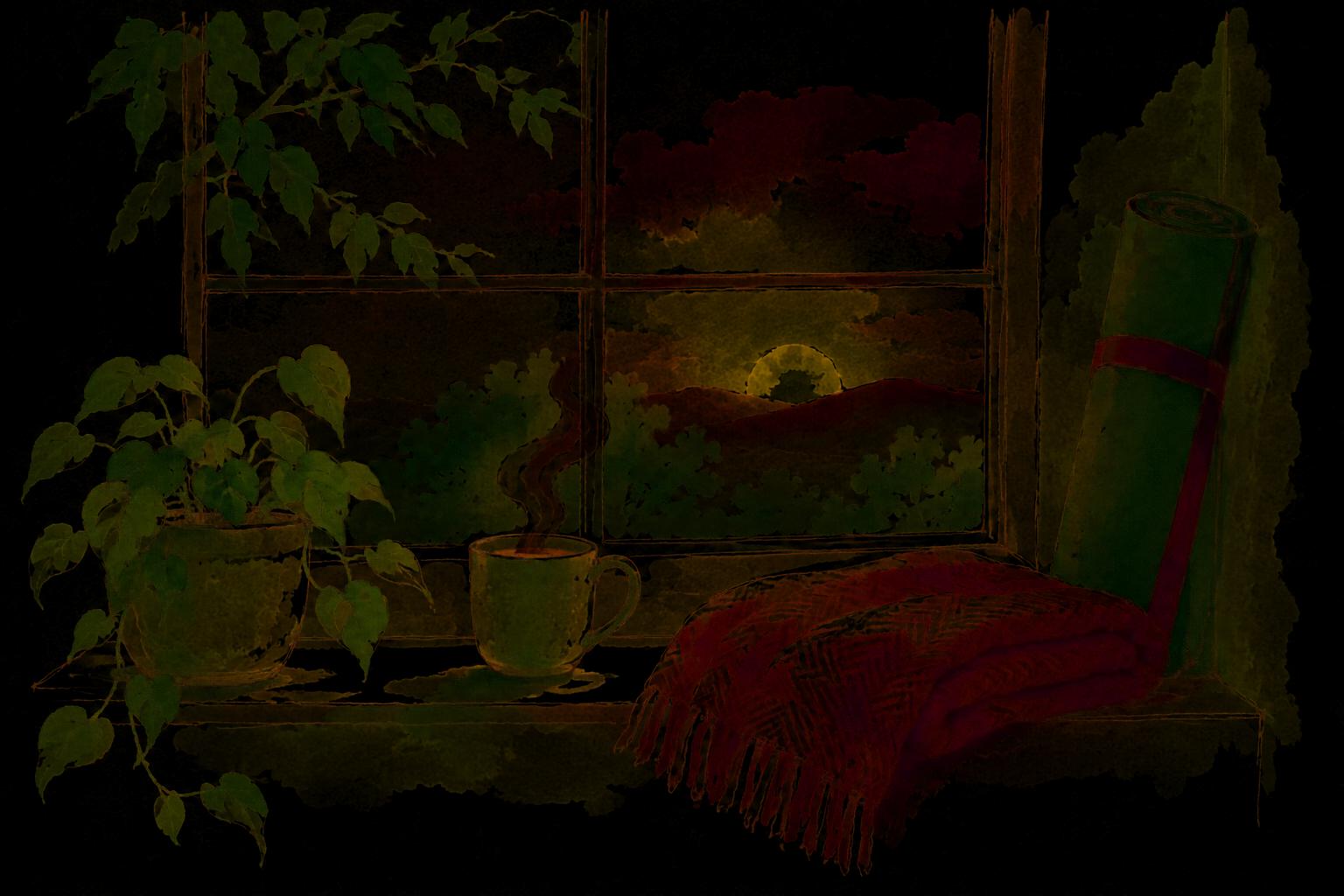
To learn how to do nothing, you set aside a little time with no task, no screen and no goal, and you let yourself stay in it even when it feels strange. You might sit on a step, look out of a window or lie on the grass and watch the sky. The hard part is not the nothing. It is the urge to fill the gap, and the guilt that says you ought to be busy.
I am a wellness coach and yoga teacher, and my days are built around movement: an hour of yoga, with running and walking around it. I have also sat a ten-day silent Vipassana meditation retreat, so I know that stillness can be practiced. But this piece is not about meditation, or exercise, or even sleep. It is about something plainer, and for many of the people I talk to, much harder: being idle on purpose, with no technique and no aim.
Doing nothing belongs to Right Rest, the fifth of the seven petals of the Starflower, the method in my book, Lifetime Body by Design. Each petal is a "Right Action", one of the few fundamentals a foundation of health is built on. I cover rest as a whole in how to rest, and the art of doing fewer things more fully in slow living. This is the smallest and simplest corner of the petal: the empty minute.
What doing nothing actually means
A lot of things look like doing nothing and are not. Scrolling a phone is input. A nap is sleep. Meditation, however gentle, has a method. Slow living is still doing things, just fewer and with more attention. Real idleness has no job at all.
| Activity | Is it doing nothing? | Why |
|---|---|---|
| Scrolling your phone on the sofa | No | Your mind is still taking in a steady stream |
| Watching television in the background | No | It fills the gap rather than leaving it open |
| A short nap | Not quite | It is sleep, which is its own kind of rest |
| A meditation practice | Close, but no | It has a focus and a technique |
| Sitting on the back step watching the sky | Yes | No aim, no input, no task |
| Waiting for the kettle without picking up a screen | Yes | A small gap, left empty |
| Lying on the grass after a walk | Yes | The body is still and the mind can wander |
The test is simple. If there is something you are trying to achieve, it is not quite nothing. That is fine. It just means the idle minute is still missing from your day.
Why it is so hard to sit still
For most of us, sitting still is not a skill we have lost. It is one we have quietly trained out of ourselves.
Every time we feel a flicker of boredom and reach for a phone, the reach is rewarded with something new to look at. Repeat that often enough and it becomes a habit loop like any other: a cue (an empty moment), a response (pick up the phone), a reward (a little novelty). Before long, the empty moment itself starts to feel uncomfortable, as if something has gone wrong.
So the restlessness you feel when you first try to sit and do nothing is not a sign that you are bad at it. It is the old habit pulling at your sleeve. Like any habit, it loosens with practice.
Where the guilt comes from
Even when we manage to stop, a voice often arrives: you should be doing something useful. Many of us were raised to see rest as a reward we have to earn, and busyness as proof that we matter. Idleness can feel almost like a moral failing.
I would put it differently. Bodies and minds were never designed for constant output. As I write in my book, we are "not machines but living beings who require cycles of activity and restoration." A pause is part of that cycle, not a hole in it.
The guilt is worth looking at for what it is: a habit of thought, often a very old one. Like other unhelpful thoughts, it can be noticed and gently questioned rather than obeyed. If that kind of inner voice is loud for you, how to stop negative thoughts may help.
Doing nothing is not a gap in your day. It is part of it.
How to be idle without being lazy
People sometimes worry that doing nothing is just laziness with a nicer name. I do not think it is. Laziness avoids what needs doing. Idleness is a chosen pause, taken between or after the things that need doing, and you come back from it ready to carry on.
In my work on movement I return often to a simple idea: effort plus rest is how anything grows. A hard run only makes you stronger if you recover from it. The mind works in a similar way. Many people find their best thinking arrives when they stop pushing: in the shower, on a walk, staring out of a train window. Doing nothing leaves room for that.
The art of doing nothing, in small doses
You do not need an empty afternoon. The easiest way to begin is to stop filling the small gaps that already exist in your day. A few natural places:
- While the kettle boils. Stand and wait. Look out of the window.
- After a meal. Sit for a few minutes before you clear the table or reach for a screen.
- Before you start the car or open the front door. A minute of nothing between one part of the day and the next.
- Outdoors. A bench, a garden, a park. Watching trees move or clouds pass is about as close to doing nothing as most of us get.
- In the evening. A few quiet minutes in a chair, lights low, before the evening routine begins.
None of these needs a method. If your mind wanders, let it. If you notice the urge to pick something up, notice it and stay where you are a little longer.
Make it a habit, small and daily
Like everything in Lifetime Body by Design, this works best as a habit rather than an occasional treat. Habit is the stem of the Starflower, and the stem grows from one small, steady routine at a time. In my method that first steady routine is called the Anchor Habit, and new habits are easiest to build when you attach them to one.
So tie your idle minutes to something you already do. Five minutes on the step after your morning tea. A few minutes in the chair after dinner. Start shorter than you think you need to, and let it grow. If you miss a day, come back the next one, and try never to skip twice. I explain the approach in how to build good habits.
If you would like guidance with the quieter practices that sit beside this, such as restorative yoga or breathing, there are follow-along sessions at Lifetime Body by Design.
When stillness is uncomfortable for other reasons
For some people, sitting still brings up more than boredom. If quiet moments fill quickly with anxious thoughts or low mood, or if you feel restless and unable to settle most days for weeks, please speak to your doctor. Doing nothing is a lovely habit, but it is not a treatment, and those feelings deserve proper support.
A few questions people ask me
Is doing nothing a waste of time? Not when you choose it. A short, deliberate pause is part of how body and mind recover, and many people find they return to their work clearer for it.
How long should I do nothing for? Start with a few minutes. That is enough to notice the urge to fill the gap, and to practice not following it.
Is it all right to do nothing on a day off? Yes. A day with long, unplanned stretches can be one of the most restful you have, as long as it is not spent entirely on a screen.
What if I get bored? Let yourself be bored. Boredom is usually the feeling of an old habit asking for something to do. It tends to pass if you stay with it.
More on rest in all its forms is under Right Rest, starting with how to rest and slow living. For making any new routine stick, read how to build good habits.
This article is general information and one person's experience. It is not medical advice. Please speak to your doctor if restlessness, anxiety or low mood is lasting or getting worse.
Carol Pocock is a wellness coach, yoga teacher and the author of Lifetime Body by Design. Guided sessions are at Lifetime Body by Design. More about Carol.

